Friday 23 December 2016
Films of 2016 and the promised 'return' of Super 8
Films of 2016
It's come to that time of year when I realise just how few films I've actually seen. (You know, properly, at the cinema). I only watched the 'Revenant' on tv last night! (Mostly enjoyed it. Great bear and horse scenes. It had Oscar-needy performance from diCaprio written all over it but I'm not going to begrudge him his plaudits). So I'm indebted to people like @davidehrlich who put together mega-montages, such as the one above, that review the year for people like me who so easily fall out of the contemporary film release loop. 2017 - must do better. I could too easily blame my 'career shift' - I have recently returned to teaching - but that just won't wash with you or me. (More on that in another post). For a more textual take on the films from 2016 go and have a read of No Film School's 'No Film School's Top 10 Indie Films of the Year'.2017: the 'return' of Super 8
Let's all take stock of 2016, and in true analogue spirit, shoot some stock in 2017! Why not? Film is making a comeback is it not? The defunct Kodak has risen from the ashes and has designed a new Super 8 for us all to get retro with. I still have a wind-up Russian Quarz Super 8 Camera that I better dust-down if I'm going to keep up with these retro times. I never did telecine my footage from the top of New York's Twin Towers that I shot in 1999. Its time has come!

Friday 8 April 2016
#Shakespeare400
I'm getting into the spirit of the Shakespeare celebrations marking 400 years since his death #Shakespeare400. I'm collecting links about events, performances, talks, screenings, research and teaching resources in a Flipboard magazine. Please take a look: bit.ly/Bard400.
Wednesday 25 February 2015
Week 4 storyboard - Watchtower - FLexplorefilm

I take heart from the fact that Martin Scorsese is not a "master draftsman" but capable enough in the drawing department to sketch out his shots for one of my favourite of his films, Taxi Driver. Read the article, watch the film:
Sunday 15 February 2015
Week 2 script - Sweets - FLexplorefilm
Saturday 26 July 2014
Some of my photos on Crated

I thought I would try a new service called Crated for putting some of my photos out there. It is purely experimental at this stage but they are for sale. There seems to be a theme here: I like pointing my camera at the sky and therefore blue is my touchstone colour but I am sure this will change as I explore street photography.
Please take a look:
https://crated.com/richardwoolfenden

Thursday 20 March 2014
Walthamstow Market


Walthamstow Market, a set on Flickr.
My first experiments with street photography.
Sunday 2 February 2014
Framed planes


Framed planes, a set on Flickr.
Some shots of the skies on Saturday before the predicted gloomy weather front this week.
Tuesday 9 July 2013
Richard Broderick Sculptor
Richard Broderick is a sculptor based in the North East of England. Many of his sculptures explore Richard's deep interest in both human, and animal, forms and his experimental merging of the two. This short film is about Richard's approach to his craft and includes film of some of his public art commissions that can be found in North and South Shields, Whitley Bay and Blyth.
I've known Richard since we were kids. Richard's skill as a draughtsman was obvious to see when we were at school. This film was an opportunity for me to catch up with my good friend and try and capture the man and his intriguing body of three dimensional work.
I hope you enjoy the film.
More information about Richard's creations can be found on his website: www.richardbrodericksculptor.co.uk
Monday 21 May 2012
The Bonfire of the Vanities by Tom Wolfe
I really enjoyed this and have been meaning to read it for a while. I saw the film a long time ago but had forgotten most of the essential details. (If I remember correctly the film was critically panned on release but I can't quite remember why). Nevertheless, the shadow of the eponymous film still cast itself on my imagination and it was difficult not to picture Tom Hanks whilst Wolfe captured the journey of his "anti-hero", Sherman McCoy (possibly not a strictly accurate term in this context, I admit). The same thing happened to me last year with 'Tess of the d'Ubervilles' and Natasha Kinski. Damn that Polanski!
It was by chance that the book I read two books before 'The Bonfire of the Vanities' (TBotV) was Dickens's 'Hard Times' and, as Wolfe explains in the introduction to this his debut novel, TBotV is his attempt at to write a great city novel with the depth and ambition as those created by nineteenth century novelists such as Charles Dickens. In fact his Introduction to TBotV, entitled 'Stalking the Billion-Footed Beast', is a fascinating study of realist and non-realist novel writing trends in the twentieth century and how in 1987 he was attempting to write a broad realistic novel about New York which was completely out of step with the more non-realist - even magical realist! - writing trends of the time. If I was a lecturer teaching students about the history of novel writing then they would all have to read this introductory chapter (and the rest of the book of course). Tom Wolfe simply critiques the "write about what you know" approach to writing as being too narrow and warns young writers that this approach can lead to the cul-de-sac of believing that the "only valid experience is personal experience".
I haven't got loads to say about the book itself right now except that it was an amazing read. If his aim was to capture the city of New York at a particular post-war moment (the late 1980s) where politics, finance and personal morality were all at their over-inflated, twisted and seething apex then he more than matched his original ambition. Unlike Dickens he dispenses with any need to have a character (or two) that are unadulterated or morally pure and instead we have characters that are very human and believably corrupt. Sherman McCoy is Wolfe's master creation, however, and in fact he is a Master of the Universe - a Wall Street bond-trader who collects enough substantial crumbs from cake makers of the world economy to afford, at a push, what passes for the high life in NYC. McCoy's tortuous journey from being the most respected and highly remunerated trader at investment-banking firm, Pierce & Pierce, (with a Park Avenue apartment, wife and daughter to boot!) to being accused of perpetrating a hit-and-run on a young black honor student, is told by Wolfe in a such painful psychological detail you might be forgiven for thinking that the story was written in the first person but no, he still manages to move between his other New York characters occupying their minds en route.
It is twenty-five years since the book was published and it still feels very relevant. The distorting and destructive impact of the politics of race and an economy over-reliant on the crumb-collectors of Wall Street are clearly still playing themselves out, if I can be forgiven a rather large generalisation. At the end of the book I was rooting for McCoy to win and perversely enjoyed the thrill he was getting from his crazed lashings out, but this, I'm afraid, is where Wolfe leaves his audience: thrashing around in the carcass of a truly outstanding city that can suck the soul from its downtrodden, huddled masses and sometimes even its most privileged inhabitants. Bleak? Certainly. An irreversible fate? I don't think so.
 The Bonfire of the Vanities by Tom Wolfe
My rating: 4 of 5 stars
View all my reviews
Thursday 13 October 2011
Three short films about the riots
Wednesday 5 October 2011
Making a music video
Sunday 12 June 2011
Markup.io - Cool Tool
Here's a page I created earlier:
http://markup.io/v/sb8pv5ybyt77
It already feels like a really cool tool. It could be very useful for quickly discussing the design of a web page with a client or member of your team. It could also quite easily be used for mischievous graffiti but I am sure no one will think of that ;)
Storify: Just another social media content aggregator?
1. Why a JavaScript hater thinks everyone needs to learn JavaScript in the next year
which led me to here:
2. Express
which finally led me to here:
3. Storify
This is a pretty nerdy path, I admit, but I am interested in how programming technologies such as Javascript - that have been around for a while, and have not always been looked so favourably on - now seem to be more central to the development of the web, and HTML5.
Anyway, I ended up at Storify which is a kind of social media story aggregating tool. Why the heck would one need one of those? I am not sure at the moment but it was extremely intuitive to use and I couldn't resist giving it a spin around the block. Here's an embed from my first try out:
Tuesday 29 March 2011
Andrew Lansley Rap inspires more angry rapping
This video has got a certain edge to it and has been doing the rounds on the internet. The enjoyment from spitting out the word "TOSSER" seems be an essential element along with the Animal's guitar loop from their evergreen classic, 'House of the Rising Sun'. The host on a Saturday BBC radio show - I can't remember which - was asking for listeners to send in their own angry raps i.e. about stuff that they were angry about. Well, I'm pretty darn angry about Libya and so I wrote a short rap. Needless to say it wasn't read out. In retrospect, I think they might have looking for faux anger, but this, my friends, my crew, is the REAL DEAL. Here me now:
You patted yourselves on the back,
When you attacked Iraq,
Now all decoys have left the house-
There is no Dubya -
You thought WTF let's bomb Libya.
You make Gadaffi look like a democrat,
You've turned a civil war into a worldwide spat.
Your credibility is now spent.
Who are you?
You are the ruling, strictly humanitarian, British establishment.
2011 © MC ECLECTIC (TRAINS)
Olympic Stadium Construction Complete
My colleague and I Xube have compiled some photos from the public access path ("The Greenway") into a little photomotion movie. I hope you enjoy it.
The Olympic Orbit Flickr set can be seen here.
Thursday 3 March 2011
Olympian construction
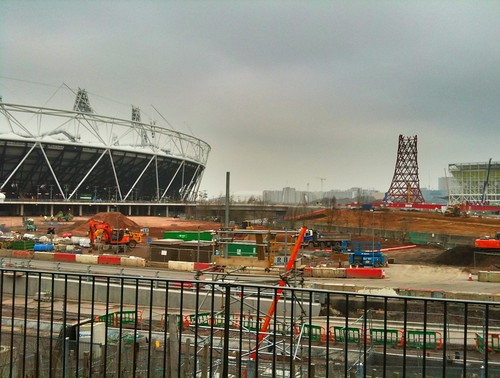
I started cycling to work again this week and so it's the first time I have seen the Olympic Park up close since October 2010. Things are progressing fast and I can't help but feel excited. There has been a lot of tired, dull press about the legacy issues. Who's going to have the stadium after the Games? etc... But the Games really feels upon us now. Anish Kapoor's Olympic structure is being assembled and the Velodrome was completed last week (on time and on budget). The structure is called the ArcelorMittal_Orbit and it will stand 115m in height making it 22m taller than the Statue of Liberty.
I am going to enjoy cycling past over the next 8 months (or until I can't take the cold) and will try to capture some of the key developments on the site on my iPhone. There are lots of Flickr Groups you can visit if you want to see pics of how the construction work is getting on. Here is a wonderful shot of the Olympic Stadium I found on Flickr taken by Chris Dorley-Brown.

Monday 14 February 2011
Tuesday 8 February 2011
Addendum: Choosing your first camera lens

Changes
Alteration 1: Subtitle: "Experimenting with my new Sony DT
Alteration 2: Paragraph 2: "On a full frame sensor camera this would be a 50mm lens but on a cropped sensor, such as on my Sony A200, this would be a 35mm lens but what I ended up buying, in fact, was a 50mm lens which on a APS-C, or cropped sensor, is equivalent to a 70mm lens. (Confused? This blog has undergone some changes since it was first written and these are explained in the addendum post)."
Alteration 3: Paragraph 2: "This
Alteration 4: Paragraph 2: "So I now have the Sony DT
Alteration 5: Paragraph 4: "Kurt Munger, a devotee of Sony cameras and lenses, has reviewed the Sony DT
Phew! Kurt is the man to read on Sony cameras and lenses. I have a lot to learn!
The photographer's brain is missing
*How did this happen? Is it a sign of the early onset of dementia? I hope not and I don't think so. I went into Jessops intending to buy the 35mm lens, saw what I thought was one on the shelves, bought it and walked out of the shop with a lens in a box that said 50mm.

I even took a picture with my iPhone (left) when I left the shop because I was so chuffed with my purchase. The 50mm lens box didn't raise any alarm bells in my head because I thought I'd asked for the 35mm lens. The very helpful shop assistant (god this is boring!) said they had only one lens of this kind left and it was the one I'd seen on display. I said as long as it worked, and I had the same guarantee, then I was happy to buy that one. She went into the back of the store to find it's box and sold it to me. Tonight, Tuesday 8th February 2011, I actually used my eyes and looked at the lens and my world came tumbling down...
Tuesday 25 January 2011
Choosing your first camera lens
The pros say "it's all about the glass stupid". They say you can have a multi-megapixel camera body but if you haven't got a decent lens then you will never get the quality shots you aspire to capture. This is all very well and good but if you are an enthusiast like me you will balk at the price tags of great pieces of glass. So what to do?
Well, do some research, read the reviews and decide on a lens that will complement your standard kit lens (which in my case is the sturdy but quite average 18-70mm F3.5-F5.6). In autumn last year Sony announced some dedicated lenses for their Alpha range of cameras that won't break the bank. (I have their entry-level camera, the now discontinued A200). What kind of lens did I really want? Well, a telephoto zoom lens would be nice but not essential for the kind of photos I'm taking at the moment which are simple portraits, family shots, still lifes and landscapes. A wide angle would also be great but again a luxury at this stage. I decided, therefore, I wanted a fast prime lens; a lens with no zoom and, by definition therefore, with a fixed focal length. I was looking for a lens that roughly approximated what the human eye sees. On a full frame sensor camera this would be a 50mm lens but on a cropped sensor, such as on my Sony A200, this would be a 35mm lens but what I ended up buying, in fact, was a 50mm lens which on a APS-C, or cropped sensor, is equivalent to a 70mm lens. (Confused? This posting has undergone some changes since it was first written and these are explained in the addendum post). I wanted the shallow depth of field look - also called bokeh - that a fast prime lens can give you. This means I can open the lens right up to f-stop 1.8 and have a pin sharp subject in the foreground (no closer than approximately 1 foot) and a luscious defocused background. This 50mm prime lens was sold to me as a great portrait and landscape camera. So I now have the Sony DT 50mm f/1.8 SAM lens. I've started to do my own tests my early results can be seen by clicking on the test photos above or by clicking on this Flickr set.
Apologies for the lack of portraits. I need to find new subjects other than my family. Soon to come...
Kurt Munger, a devotee of Sony cameras and lenses, has reviewed the Sony DT 50mm f/1.8 SAM lens and his great technical report can be found here: http://www.kurtmunger.com/sony_dt_50mm_f_1_8_samid147.html.
Oh, and of course this fast prime lens is very handy in low light. Which means you can hold off from using that flash.
Wednesday 12 January 2011
My New Year's Resolution: an iPhone pic a day
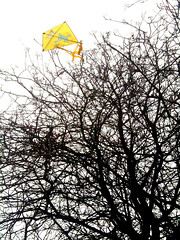 |
| 6/i365 - Stuck! |
"Mmm... yes I gave up smoking in 1998," I said.
"Did you find it hard to keep to? Did you have to write yourself post-it notes and stick them round the house to remind you of your resolution? That's what people are telling me that they have to do," prompted my desperate interviewer.
"No I didn't," I replied.
"How did you give up then?" he asked despondently. (I hadn't given him the answers he was looking for).
"Force of will," I said.
"Ha, ha the old 'force of will," he laughed and disappeared into the night. Defeated.
My daughters and I were bemused. They asked me what he wanted and I told them that I wasn't quite sure. It made me think that a New Year's resolution might be a nice-to-have for 2011 and then along came an invite to join the i365 (iPhone Photo per Day in 2011) from a friendly photographer called John Kershner of the Flickr photographic community. I'm not sure why I was invited but I'm very happy to have been. I'll put it down to one of those serendipitous social media experiences.
So, I am now committed to take one picture a day on my iPhone (3Gs) and upload it for my fellow i365 group members to see and anyone else who stumbles onto the Flickr online photo management and sharing website. I'm really enjoying the challenge. It appeals to my love of disciplined eclecticism. If you would like to see my 11 shots so far then please visit my i365 set.
Thanks John! Happy New Year!